
Not My Scene
A Follow Up to An Earlier Essay

Elena Velez unfollowed me after this take down citing this essay started circulating again. I expected that. We were something like public acquaintances, which is a relationship that only exists in New York and only between people who disagree about enough to make the proximity interesting.
I went to the New York Young Republicans Gala to report on it and ended up in her orbit. I was invited to her shows in September 2025 and February 2026. After the September show my friend DJed the afterparty without knowing who Remilia or Velez was. CFCF dropped out of this year's afterparty once he found out.

A photo of me in an “I Was Cloutbombed by Peter Thiel” shirt with Izzy Capulong got shared on her Twitter. The leftists sharing it thought it was an own. The people in her orbit probably thought it was something else. I was the same person in both readings and neither reading was wrong.
✸
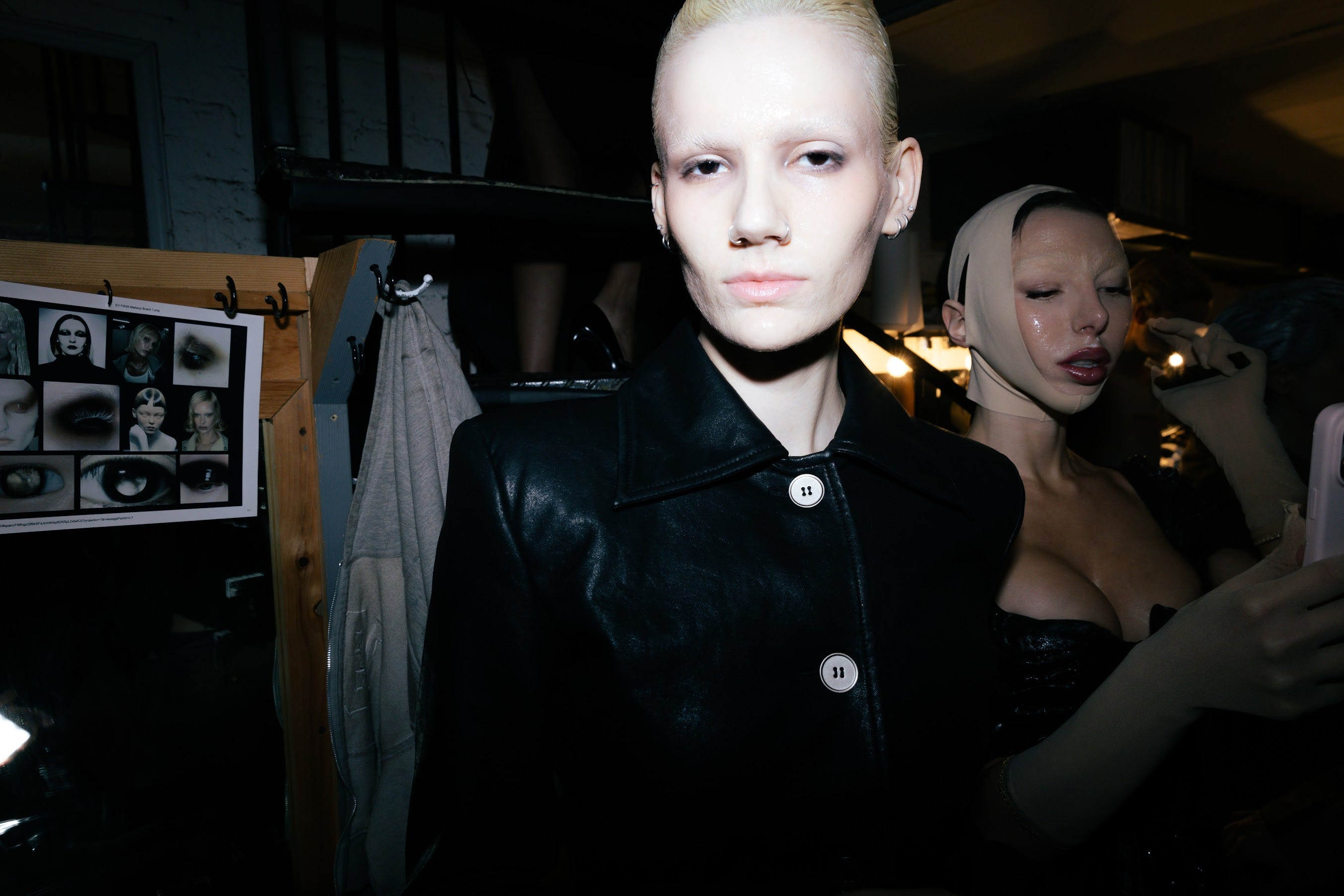
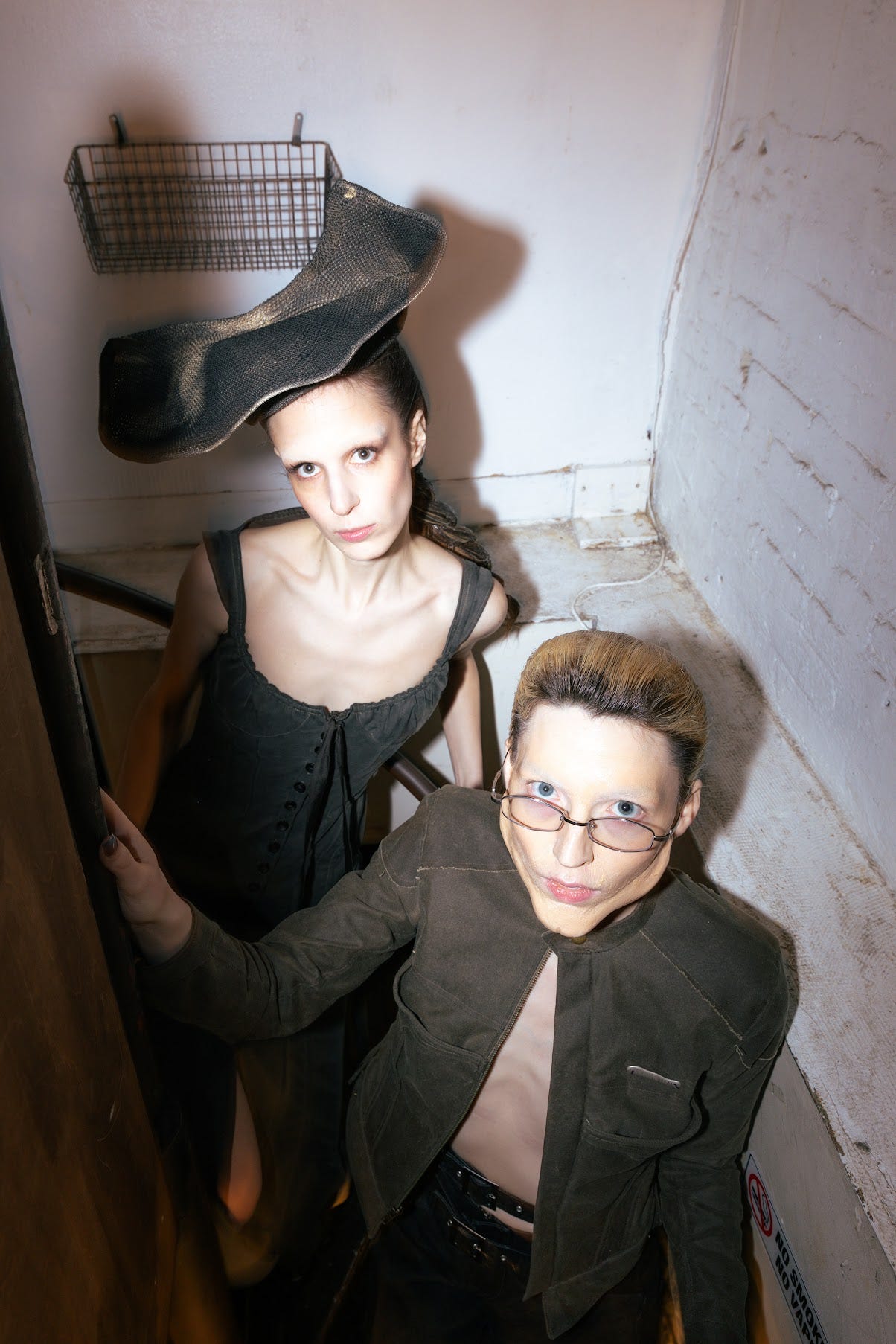
The February show, MANUS MAXXIMA FW 2026, was probably her strongest collection I’ve seen in-person. She sewed the garments herself. Critics cared. Horyn called the clothes mean but commercial. The runway looked like a cosmetic surgery recovery ward. Chin straps, dental restraints, prosthetic cheekbones, bandaged torsos. Corsets tighter than usual. Models mid-procedure, mid-recovery, mid-something.
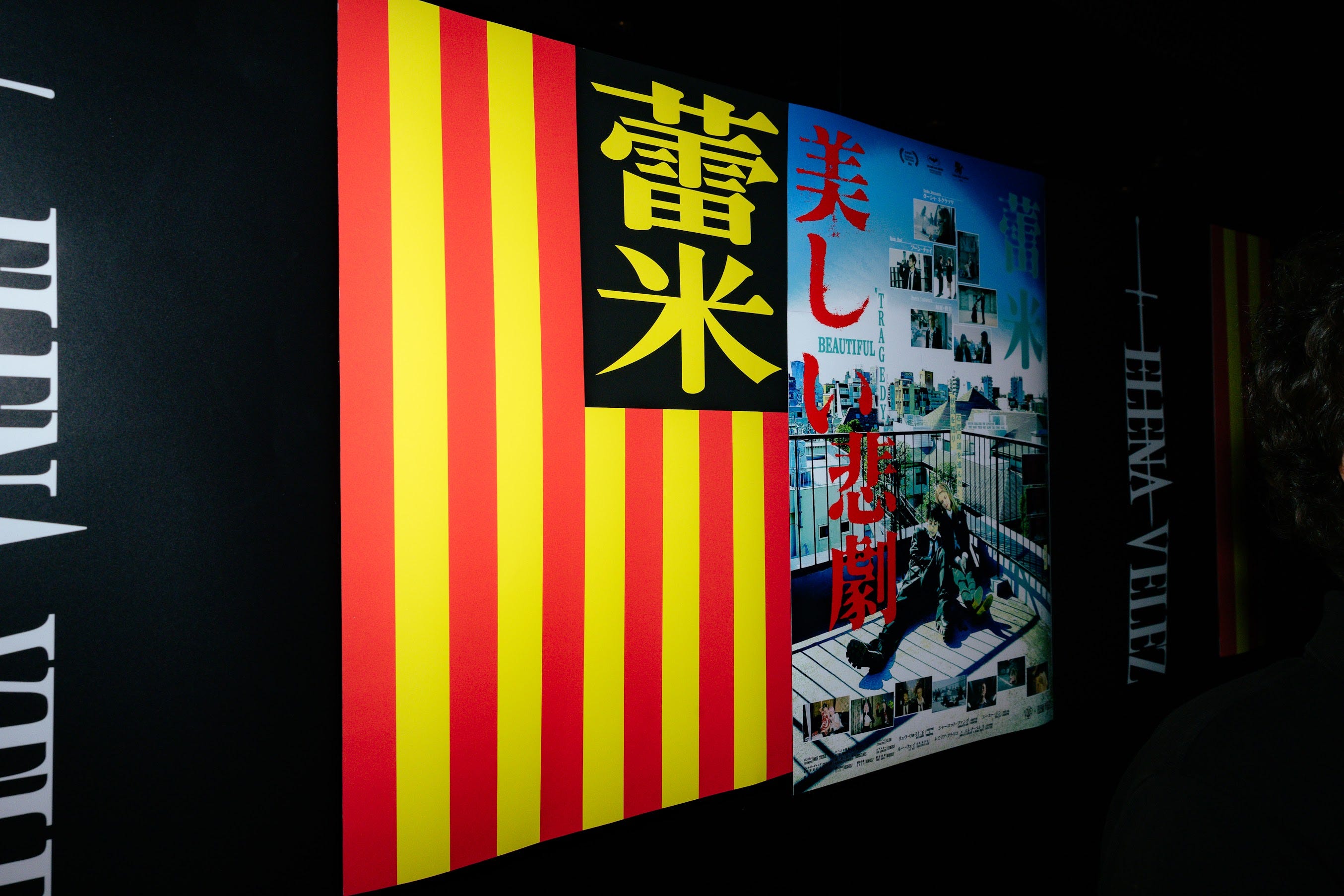
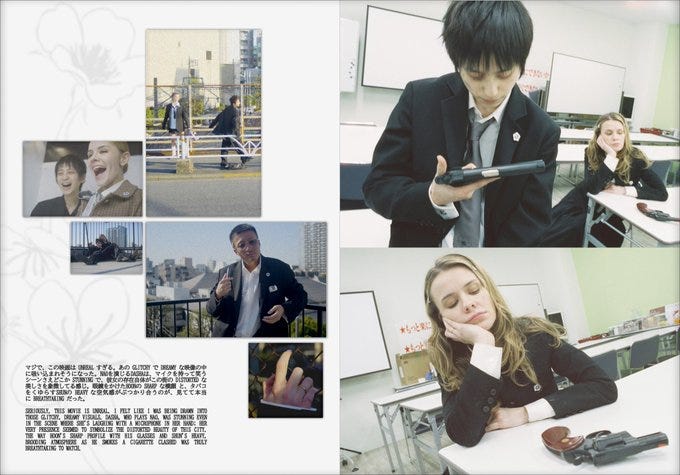
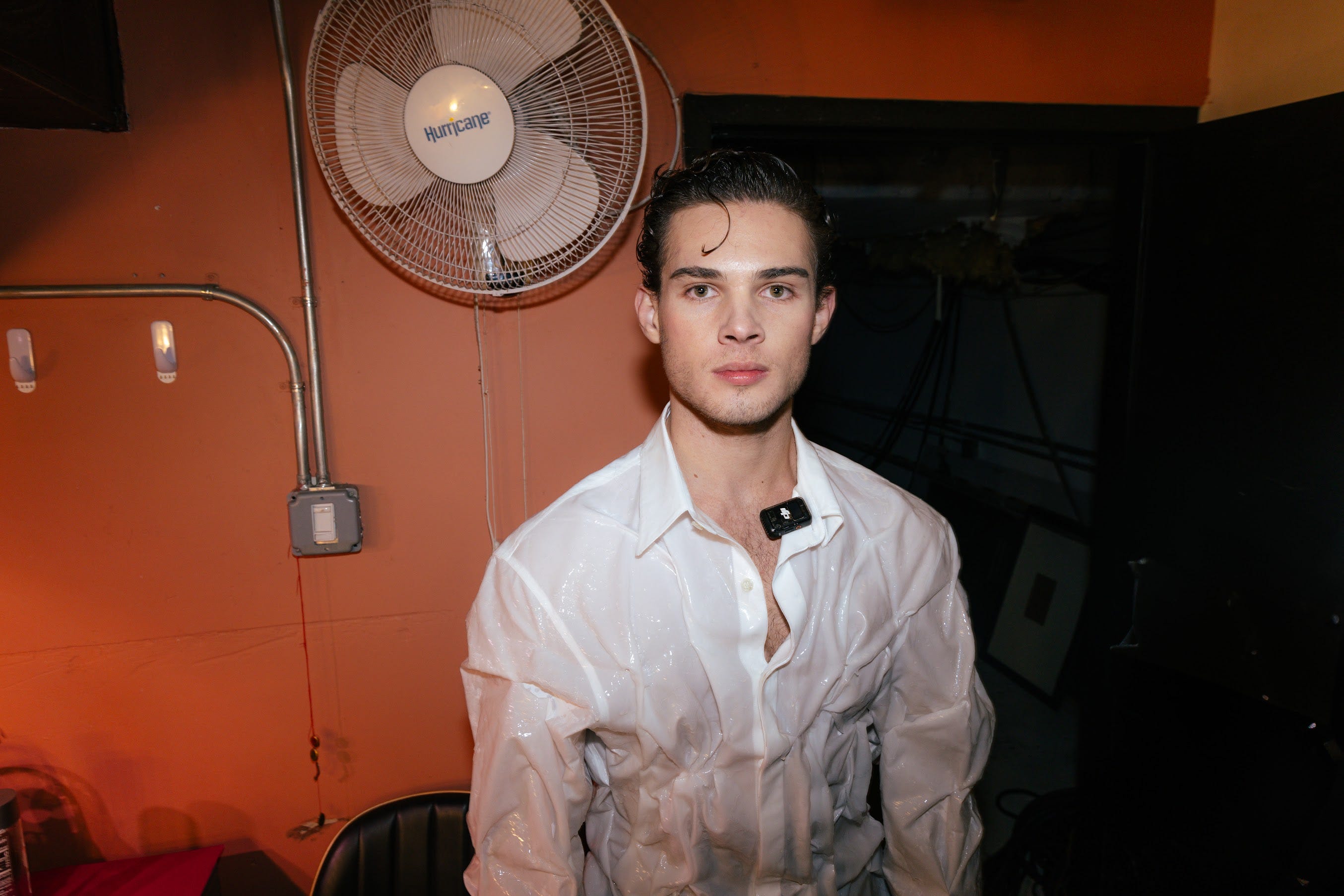
Accelerationism was supposed to be about capital consuming itself. This was that, but applied to the body. Self-optimization accelerationism, if you want a name for it, though naming it makes it sound more intentional than the show felt1. Maybe the body as the last market left to destabilize? Liv Schmidt walked. The Skinni Société founder, banned from TikTok after a Wall Street Journal piece on disordered eating. It tracked2. The casting was her most diverse of the two shows I've seen, which got noted the way these things get noted before the next thing happens. The next thing was Clavicular walking in a Yakuza-inspired “wet” billowy shirt from the Remilia collaboration accompanied with a 90’s-style Japanese magazine3.
I know this will be controversial to say but for Velez casting Clavicular was the safest thing Velez has done in this era of her career. He was already profiled in the New York Times before the show, and the kind of figure who would inevitably generate more coverage after it, which he did. GQ, Piers Morgan, the Adam Friedland Show all followed. Pre-processed in one direction, further processed in the other. The outrage was smaller in context than it looked, mostly because Velez’s own record has already generated more controversy than any guest could as documented in this round-up citing me. The FAIR fellowship. The ICE agent captions, which read differently after the killing of Alex Pretti in January. The fashion show sponsored by race realists where Khachiyan mocked George Floyd. The election night “huge night for me.”
She wants to frame it as heterodox, as punk, as post-political provocation, but that's not how her critics read it and at a certain point the framing stops mattering more than the pattern.4 Everyone starts out thinking they're the exception especially artists and thinkers. Then you make a series of decisions, friendships, affiliations, rooms you keep showing up to, and each one narrows what's still possible. The self calcifies around its commitments. We spend so much of our life trying to be accepted somewhere and you were, and now that somewhere defines you more than you define it. That's not a political observation. It's a developmental one. It applies to her. It applies to me. It applies to anyone who stayed in a scene long enough to forget they chose it.
Clavicular fit the thesis of the show. Someone who openly discusses steroid abuse he says left him infertile and endorses hitting your own face with a hammer to restructure bone. A body that had already done to itself what the clothes were simulating. On the runway he functioned less as a political statement and more as the collection’s most literal artifact alongside Schmidt.
He says he hates politics. On Matan Even’s podcast he rejected race realism right after joking that Marlon couldn't looksmax because he was black He pushed back on people calling him gay while doing the alt-right white guy bit — say the slur (n-word), laugh, move on. He told Knowles he'd vote for Newsom over Vance because Vance is ugly. These are aesthetic positions dressed as irreverence, and he may even believe they're just that. But chanting along to Ye's antisemitic track with Fuentes and the Tate brothers and then treating the fallout on Piers Morgan as a PR nuisance doesn't become apolitical because you say so. That's not how any of this works. Audience capture operates regardless of intent. You build the audience, the audience builds expectations, the expectations shape what you're willing to say and not say, and eventually the conveyor belt is moving you in one life direction whether you're steering it or not5.
Hence, why the company you keep and the algorithm that distributes you shape what you become whether you signed up for a position or not. Red Scare didn’t set out to be a pipeline either. He’s twenty. He may not understand yet that the internet keeps the affiliations even after you drop the ideology.
✸
People think the internet works by argument. You post a position, someone rebuts it, the better take wins. It doesn’t. Creators who mostly post non-political content but occasionally weigh in on the news shift their followers’ attitudes more effectively than political influencers do (Wired)6. The parasocial trust is already built. The audience doesn’t evaluate the argument and they’ve already decided they like you.
And the drift is incremental. Someone shifts a few degrees rightward — not enough to notice, not enough to lose old friends over, but enough that the algorithm starts serving a different feed, different replies, different rooms. A year later the social world has reorganized around the new position. The old connections attenuated. The new ones feel natural because they were never chosen all at once. They accreted. And now the only people who feel like your people are further right than you were when you started, which means the next few degrees feel even smaller. That’s not radicalization the way anyone imagines it. There’s no moment of conversion. There’s just a slow rotation of the social field until the only faces you recognize are facing the same direction. I watched this happen to a friend over the last year. It started with comments about Muslims that didn’t sound like him, then IQ discourse, then the full taxonomy: birth rates, civilizational decline, the whole script. I spent weeks that winter arguing with him before I realized I wasn’t arguing with him. I was arguing with his feed diet, downstream from LibsofTiktok and Endwokess on X. The person I knew hadn’t been persuaded. He’d been replaced, gradually, by the social world he’d drifted into, and by the time I showed up to debate the ideas he couldn’t even tell me where he first encountered them. They just sounded right. They sounded like everyone he talked to.
Clavicular isn't potentially harmful to the kids who want to grow up to be him because he has a political project7. He's ambient. Same as Velez. The politics don't announce themselves. They accumulate. Even incoherent. Especially incoherent. You can argue with a position. You can't argue with a style. I've described this elsewhere as ambient social life. The vibe was atmospheric. Voluntary. You could leave. The algorithm is compulsory. You're in it before you know you're in it. But ambient fame is also disposable fame. Ubiquitous the way Hawk Tuah was ubiquitous. Until it isn't. The attention evaporates. What stays is the residue. The attitudes absorbed while everyone watched a twenty-year-old hit himself in the face. You don't notice until the gas has filled the whole room as my friend, the poet Kitty St. Remy, said that it’s invisible until it's suffocating you and by then you're already breathing it in.

What happened after the show made the split visible. Twitter was nothing but the Velez show and the Remilia afterparty for days. It was the most talked about thing at fashion week in highly-online and right-wing spaces. The people in her orbit wrote about her the way they always do. Monica Sobchak in The Spectator, who modeled in both the Longhouse show and the Gone With the Wind salon, wrote that Clavicular mogged the room and that the algorithm had stepped onto the runway. Emma Evatt in The Turtle Dove framed the September show as American mythmaking and the rekindling of national identity through craft. Velez told her she sees contemporary America as a spiritual wilderness.
The show notes referenced blood sacrifice. This is how her friends narrate her work. Meanwhile Pisano’s response to the Clavicular coverage was that Vogue was platforming a rapist (Alexander Wang) and GQ was platforming a Nazi, big week for Condé Nast. Then weeks later, an Instagram carousel went viral on a completely different part of the internet, compiling her affiliations into slides as mentioned and linked above. A passage from this essay was cited. The post did what those posts do. Circulated, confirmed opinions, gave people without opinions a carousel to screenshot. Peaked and flattened in a week. One side builds the mythology. The other compiles the receipts. They don’t overlap. They barely acknowledge each other exists except on the margins in scene reports and essays.
It was different when Compact called it a “racist dress up ball” or when someone like me who’s been loosely associated with Dimes Square called it “boring contrarianism”. Those came from inside the room. The leftist Instagram take down post came from outside. My writing about Velez in 2024 was trying to map this split. She had the mainstream establishment, a CFDA award, an LVMH semifinal, and then after those accolades she courted the edgelord internet that treats her shows as an extension of posting. The problem isn’t that she can’t manage the contradiction. It’s that the contradiction keeps producing disruptions she can’t choreograph. I’ve never liked a safe artist.
Whether it impacts her work is the wrong question. The funding is stable. She's a fellow of FAIR. The controversy isn't a threat to the brand. It is the brand. The real question is simpler and nobody wants to ask it: does the edgelord internet have any value for a designer who already had mainstream success or does it just generate noise. Rips of I-D called it a show where interest in clothing is secondary to stunt casting. Forbes said her social presence is more memorable than her collections. Byeline found the clothes unmemorable and the provocation more atmospheric than designed.
It seems there is a pattern in the reviews. The clothes are there (not sure who would buy them) and they keep getting upstaged by the person making them8. Maybe that's the design. The influencer-designer as her own model. Stunts for the algorithm instead of stunts for the press. Different audience. Both machines. The right-wing media ecosystem that sustains her is only getting stronger while the fashion establishment can't decide whether to reject her or absorb her so it does both and calls it a mixed review. This is what a new ecosystem looks like. Not a disruption. A parallel infrastructure. She doesn't need the old one to approve. She just needs it to keep paying attention, which it will, because attention is the one thing it can't afford to withdraw. The clothes aren't the artifact. She is. She always was.

The reviews of this year's show were mixed, which is itself the evidence. Forbes, I-D, Byeline, Pisano, and most reviews leaned critical. Horyn had a mixed review but left the politics alone. Everyone else was ambivalent or folded her into a trend piece. Tashjian addressed the show indirectly, trying not to give it oxygen, which is its own kind of review. The only unambiguously positive coverage came from inside her orbit. Sobchak and Evatt, both of whom had modeled for her or written about her as mythology before the show even happened. That's the ecosystem developing in real time. The mainstream press hedges. The critics outside her world dismiss. The writers inside her world mythologize. And none of them are reviewing the same show.
✸
The problem with traditional fashion criticism is that it needs a thesis to evaluate. It assumes a stable field: the designer has a position, the critic locates it, the review makes sense. But the algorithmic habitus doesn’t produce positions. It produces dispositions that feel like taste, generated by unstable filters coalescing at the speed of culture and dissolving before anyone can name what they were. The field isn’t just shifting. It’s reconstituting itself every time someone opens the app, and by the time the review is filed the environment that produced the show has already mutated into something else.
No legacy media critic trained on runway reviews has a vocabulary for a multitude of internet subcultures converging on a single runway and dispersing before the lights come up. Chloe Iris Kennedy identified this shift early: once livestreams made the runway accessible to remote audiences, the focal point of the show moved from the room to the screen, and physical attendance became part of the content rather than the context for it9. What I'm describing is the next stage. The screen isn't Instagram Live anymore. It's the feed itself, and the subcultures that populate it don't just watch the show — they metabolize it into competing narratives before the models have changed.
Echoing Tashijan, it’s probably my last year at the afterparty. I said that morning I didn’t want to go. My friends convinced me. I got them past the line and on the list.
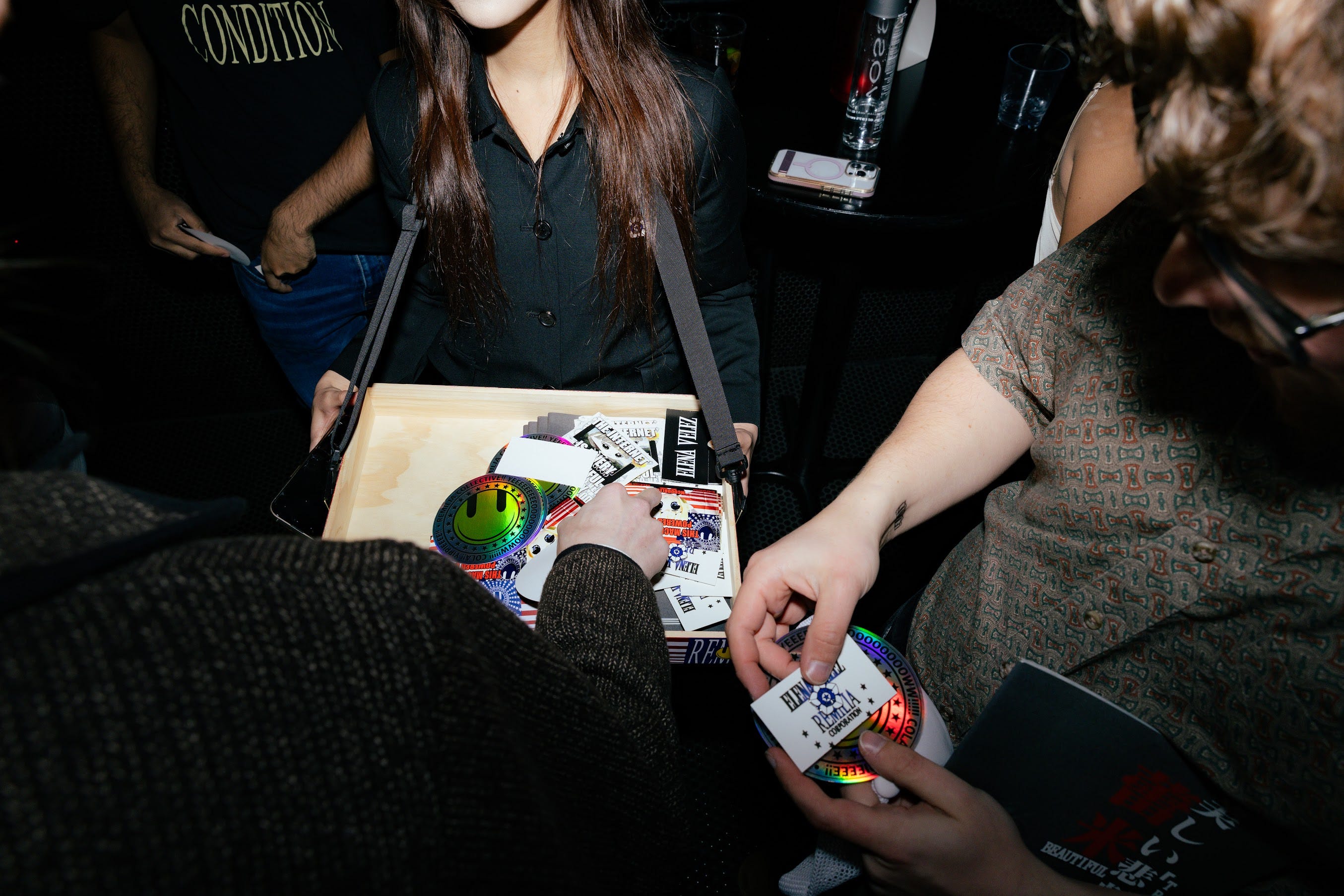
It's not my scene. The only people I hung out with were the people I brought and we were the largest group at the party. I like bridging contradictions. In practice that means standing in a room full of true believers wondering what I'm doing here. There aren't two internets. There are many. The one that builds the mythology. The one that compiles the receipts. The one that doesn't know either exists. The one where “elena velez is a disgusting freak for constantly offering her throat to the nazi right wing so that they can stick their boots in it.” The one where Clavicular is just a funny guy who hits himself in the face. Agro Studio is Temu Elena Velez. The one where he's a Nazi pipeline and "eugenics-inflected beauty standards, social Darwinism, misogyny, and performative bigotry." Parsonslop. The one where none of this registers at all. And, none of them describe what it felt like to be in the room but what it meant. I wanted to make sense of it. I'm not sure I care anymore.
A friend helped me put this differently: ideas now spread through contagion rather than debate — they're social and affective before they're ideological10. But contagion isn't quite right either, since it implies a clean transmission event, a patient zero the receipts internet would love to identify. This is messier than that. It's environmental. You don't catch a position. You acclimate to one. Nobody in these audiences adopted a politics because someone made a case for it. They absorbed an orientation because they were already watching, already trusting, already laughing at the same things. The attitude precedes the ideology, and by the time the ideology arrives it just feels like common sense — something you already believed before anyone said it out loud.
Elena Velez unfollowed me sometime while I was writing this. It gave me the motivation I needed to finish.
When we first met in person Velez laughed when the former Sovereign House manager called me antifa and still invited me to her show, knowing we had almost nothing to agree on politically. That's the part people can't metabolize. The person I'm writing about is not the person I'm writing against, but that distinction has become almost unspeakable. Critique and hostility get collapsed constantly now, especially online, where any attempt to understand something gets read as either endorsement or attack. Everyone unconsciously acts like Alex Jones in this interview, one word per person. Patriot. Vampire. Nationalist. Eugenicist. Scared man. Opp. Ally. Fascist. Antifa. The reptilian brain loves a label because it's faster than the alternative, which is continuing to scan your environment, and scanning is uncomfortable because it means you haven't decided yet, and the delay gives other people time to decide for you.
I’ve been told not to write about this. People on the left who think attention is oxygen. People adjacent to the scene who’d prefer the whole thing stay illegible. I sat with that for a while. I’m not sitting with it anymore. I’m letting it go.
If you want to silence the people trying to understand what’s happening, the only ethnography you deserve is your own echo chamber. And echo chambers don’t produce understanding. They produce more figures like her, and less ability to reckon with any of them.
Last updated March 1st, 2026. Responses to this article:
”While profiles (and novels) are not endorsements of the politics they depict, they certainly lend credibility to the reactionary party scene. Matthew Donovan has written a fascinating piece in this vein about the platforming of Clavicular by fashion designers like Elena Velez. The tricky thing for writers is to understand the difference between endorsements, satires, and reporting.” Grace Byron, contributor The New Yorker, GQ, Vogue, and elsewhere, in her essay “Look Mom I’m a Hegelian E-Girl”
”Technology, in the McLuhan sense, was supposed to be an extension of the body, but in Land’s formulation, the body is an extension of technology until it doesn’t even need the body anymore and it’s all machines. Plastic surgery is great, but Donovan’s “Self-optimization accelerationism” is a real thing, you know it when you see it, it’s the final stage in the transition from human to machine which Land calls the very “history of capital.”” Geoffrey Mak, contributor to Spike Magazine
“[This is ] easily the most interesting work I’ve encountered on Elena Velez. it takes someone with one foot in the scene, who can sit with the ambitions of an edgelord, to really break it down for us chronically online normies” Dia Lupo
“this really is a very good read of what this type of thing “is.” I think it’s kind of what people tried to articulate when this type of escalating attention-seeking behavior hit the world of electoral politics but couldn’t” Amanda Killian
So, the Forbes reporter backstage was told that Clavicular didn’t really know anything about the designs or the designer. The thesis of the show was self-optimization accelerationism. I need you to hold both of those sentences in your head at the same time. The guy whose entire function was to be the final word, the culminating body, the last thing you see before the lights come up and everyone pretends to know what they just witnessed, this guy walks off the runway and says yeah I don’t know what that was. He didn’t know whose clothes he was wearing. He was just there. He was just moving forward. He was, and I cannot stress this enough, accelerating. This is either the funniest thing that happened all night or it’s so damning that everyone involved should be forced to take a year off, go offline, and learn to access their brains again. There is no middle position available. Because OK so you make a show about how we’re all barreling through systems of meaning without stopping to actually understand what we’re participating in and then your closer, your anchor, the physical vessel of your entire thesis, he goes backstage and confirms, to a reporter, on the record, that he was in fact barreling through a system of meaning without understanding what he was participating in.
Schmidt told the Wall Street Journal she has "a very cultlike group of girls following me" almost as a selling point to advertisers. She was 22 at the time, not an expert in health or fitness, and her TikTok got banned mid-interview after the Journal called for comment. She responded by directing her followers to her other platforms and telling them "you lost the privilege." She then walked this Velez fashion show themed around the violence of self-optimization. Nobody involved seems to find this sequence unusual.
The Remilia press release described the Velez collaboration as "interrogating luxury fashion products as a form of industrial lifestyle design." Charlotte Fang writes like this, critical theory pitched at an audience that doesn't think or write in critical theory, which makes it read less like insight and more like insulation. Brad Troemel's term for this kind of thing is art-speak, but to most people it reads as gibberish, and it fits. The ideas aren't bad, they're just buried under a style that seems designed to prevent anyone from checking whether they're actually there. I’ve written like this for years.
Remilia press release described the collaboration as "interrogating luxury fashion products as a form of industrial lifestyle design." They really need to quit the art-speak-gibberish writing style (Brad Troemel). TLDR. Charlotte Fang's could be more clear. He writes in a critical theory-academic in highly online space where people don’t think and write like that. It doesnt fit.
There was a lot of discussion on Twitter this day about whether Velez makes right wing art, whether right wing art exists, but it’s safe to say she is just right wing in an incoherent, highly-online way.
The biographical facts are worth holding separately from the political argument because they're doing different work. Clavicular has admitted to meth use on stream, injecting fat-dissolving agents into his underage girlfriend on Kick, and running over a stalker with his Cybertruck while livestreaming. He has an anonymous benefactor who reportedly sent him half a million dollars in three months and who the internet conspiracy theorists believe is Peter Thiel, which he denies. His Arizona arrest for possession of illegal substances and a fake document was dropped days before the Velez show. None of this coheres into a politics. It barely coheres into a person. But that's the point. The incoherence is the cover. You don't scrutinize someone who presents as pure chaos because there's nothing stable enough to hold accountable. The ambient politics argument I'm making in the essay is about how influence works passively. These facts suggest something less passive is also happening, but it stays invisible precisely because everything around it is so loud and so incoherent that no one can figure out where to look.
The study I'm referencing is from a December 2025 report by researchers at Columbia and Harvard, covered exclusively by Wired. They tracked 4,716 Americans over five months and found that creators who rarely post about politics were three times more persuasive than political influencers per political video. The mechanism is parasocial trust. You build a relationship around personality, lifestyle, humor, whatever, and then when you occasionally weigh in on politics the audience doesn't evaluate the argument. They've already decided they trust you. The study also found that a control group allowed to scroll social media normally drifted rightward, which the researchers attributed to the right-leaning nature of the platforms themselves. Samuel Woolley, who studies digital propaganda at the University of Pittsburgh, reviewed the research and said it "concretizes what a lot of people have been hypothesizing." The Trump campaign appears to have understood this instinctively, sending surrogates onto dozens of small niche podcasts hosted by creators who don't normally talk about politics, while Democrats spent hundreds of millions on celebrity endorsements. This is the infrastructure behind ambient politics. It's not built on argument. It's built on proximity.
His influence cannot be seen yet but we can see already in the case of another streamer that he is influencing more white people to say the n-word such as the streamer Cheesur. He also asked his sister if she wanted to do a karoke song with the n-word in it, others seen this as pressuring his younger sister. He has been confronted by several people about this such as him wearing a hat with this word on it, this time, this time, this time, etc.
Ella Devi has argued on TikTok that few stores are actually buying Velez's clothes, and those that do are discounting stock as much as 75% off. She also suggests Velez struggles to land brand partnerships because she isn't brand safe. If true, this reframes the parallel infrastructure point: the ecosystem sustains the designer's visibility but not necessarily her sales. The attention is the product. The clothes are the pretext. I also have sympathy for Velez being an emerging designer under great financial pressures.

This formulation comes from a conversation with Geoffrey Mak. What I'm describing resembles Bourdieu's habitus, the idea that social environments produce dispositions that feel like personal taste rather than external conditioning. But habitus assumes relatively stable fields: family, class, education, institutions that reproduce themselves slowly. The algorithmic habitus is faster, thinner, and more disposable. The field reconstitutes itself every time you open the app. The dispositions it produces are real but the environment that produced them might not exist in six months.
very interesting, thanks for this!
Loved this, Matthew !