
What a Selling Show Tells You While No One Reviews It
Notes on Set in Stone, David Zwirner and Galerie Kugel


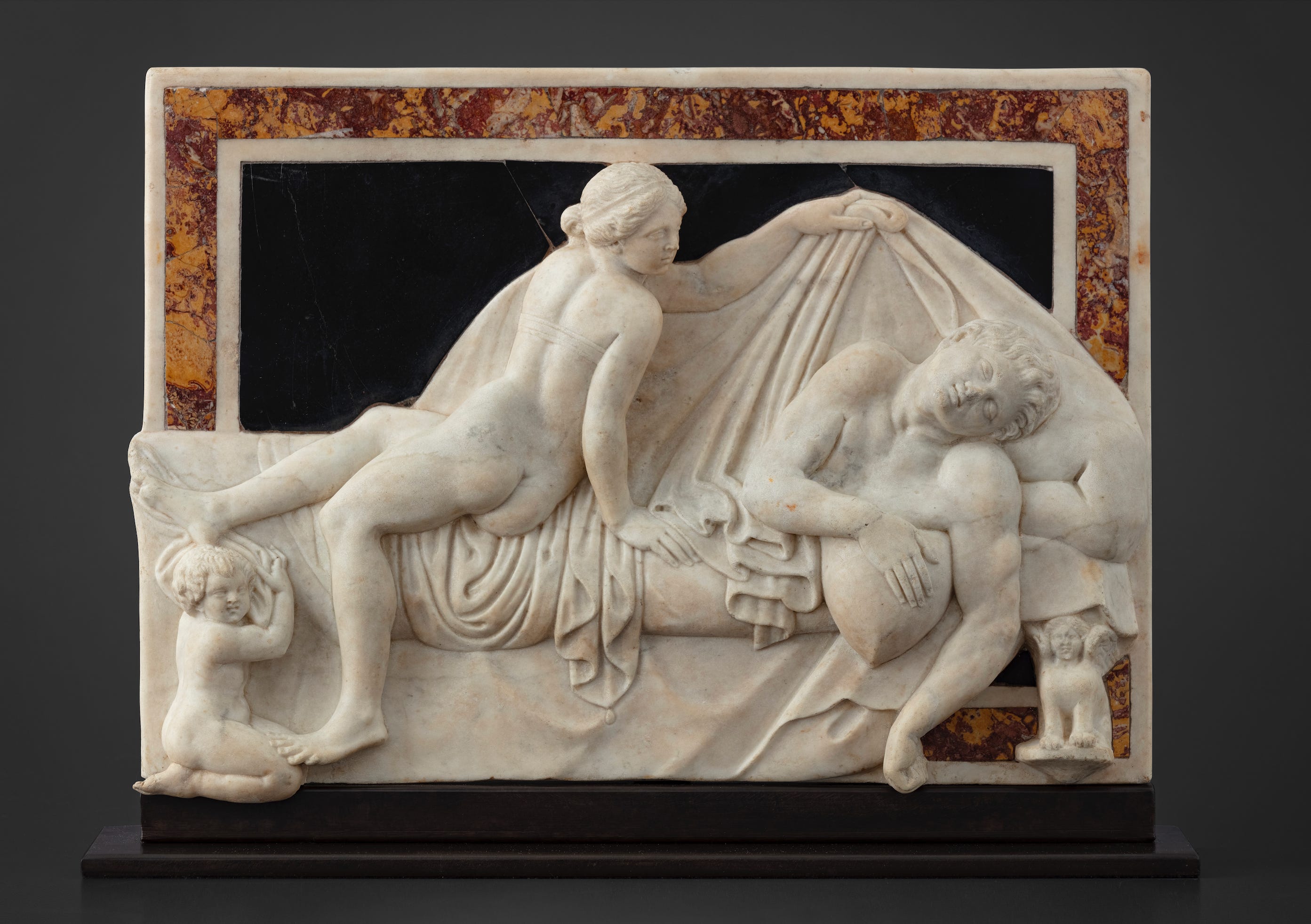
I went to see Set in Stone at David Zwirner's 69th Street townhouse last week, in the dead stretch between Frieze and Memorial Day. Almost no one has written about it as an argument, and I keep wondering why, because it seems to me the clearest map I have of where the top of the market is going. It looks like a refined pairing of antiquities and contemporary art. I think it is something closer to a selling instrument, built down to the lighting and the wall labels for the people about to inherit the largest transfer of wealth in history. None of that is in the wall text. You have to get it from the objects, or I did, which may just be the way I happen to look.
Which is the only thing I know how to do anyway. I have a membership at the Frick and nowhere else. I go about once a month, usually with friends, and the thing we do is stand in front of a painting and guess where it is from and roughly when, before we read the placard. You commit to a read, then let the label correct you. It is a good way to look, and it is more or less what this review is, run on a commercial show instead of a museum wall.
The Frick is a block north. It is where I learned the game. Set in Stone was put together with Galerie Kugel, the Paris dealer in pre-twentieth-century art, and in 2015 Kugel sold the Frick a Saint-Porchaire ewer attributed to Bernard Palissy that has hung in the Enamels Room ever since. The same dealer that sold the museum its ewer organized this show. I am still not sure the frame and the selling were ever two things and I assure you that is not a complaint.1 It is also why a room of first-century sardonyx and seventeenth-century amber is open on 69th Street with no ticket, where someone with one membership stands as close to it as the people buying. The selling, I think, is why the looking is free.
The show is organized by Emma Kronman, an independent advisor out of Christie's Old Master Paintings who trained at the Courtauld, with Kugel, now in its fifth and sixth generations, whose objects have ended up in the Louvre, the Met, and the Getty. The contemporary work is Zwirner's. Four categories hold it together, Assembled, Colorless, Translucent, Luminous, named for what the light does when you stand in front of the thing and not for when it was made. Everyone hires the museum curators now, the ones who get written about.2 Kronman came up through the auction house instead, and you can feel it. At Christie's the scholarship and the price ride in the same lot entry; the connoisseurship was always there to move the work. The dissertation stays in the drawer, ready if she ever needs to play the scholar-curator. She could have built the show out of the history. She built it out of surface, the version you can walk into without a degree, and I mean that as a description. The training is what keeps the choice from looking cynical, lets the buyer off the hook, and the degree on the wall lets a collector want the easy version of the object and call the wanting taste.
The most useful thing anyone said to me about the show came from a gallery attendant on the second floor.3 Not the wall text. She told me the Kugel family does not hang these objects against white walls; at the Hôtel Collot they sit in crowded rooms with other antiques and the eye just slides off one onto the next. Matias and Laura Kugel had been in the building that morning. Missed them by a few hours. Zwirner's space is a house like that too: a townhouse, the fireplace mantels and built-in shelves still in the walls. The Frick and the Hôtel Collot are houses like it, kept opulently full, while this one they emptied. A bookshelf with no books still says "library." You keep the whole shape of a house full of things and carry the things out, and then there is nowhere for an object to hide, one alone against the bare wall. The same arrangement is how a thing becomes a lot, set out alone to be looked at and, the same gesture, to be carried off, priced, gone, the gap where it stood still saying "estate" the way the empty shelf says "library."
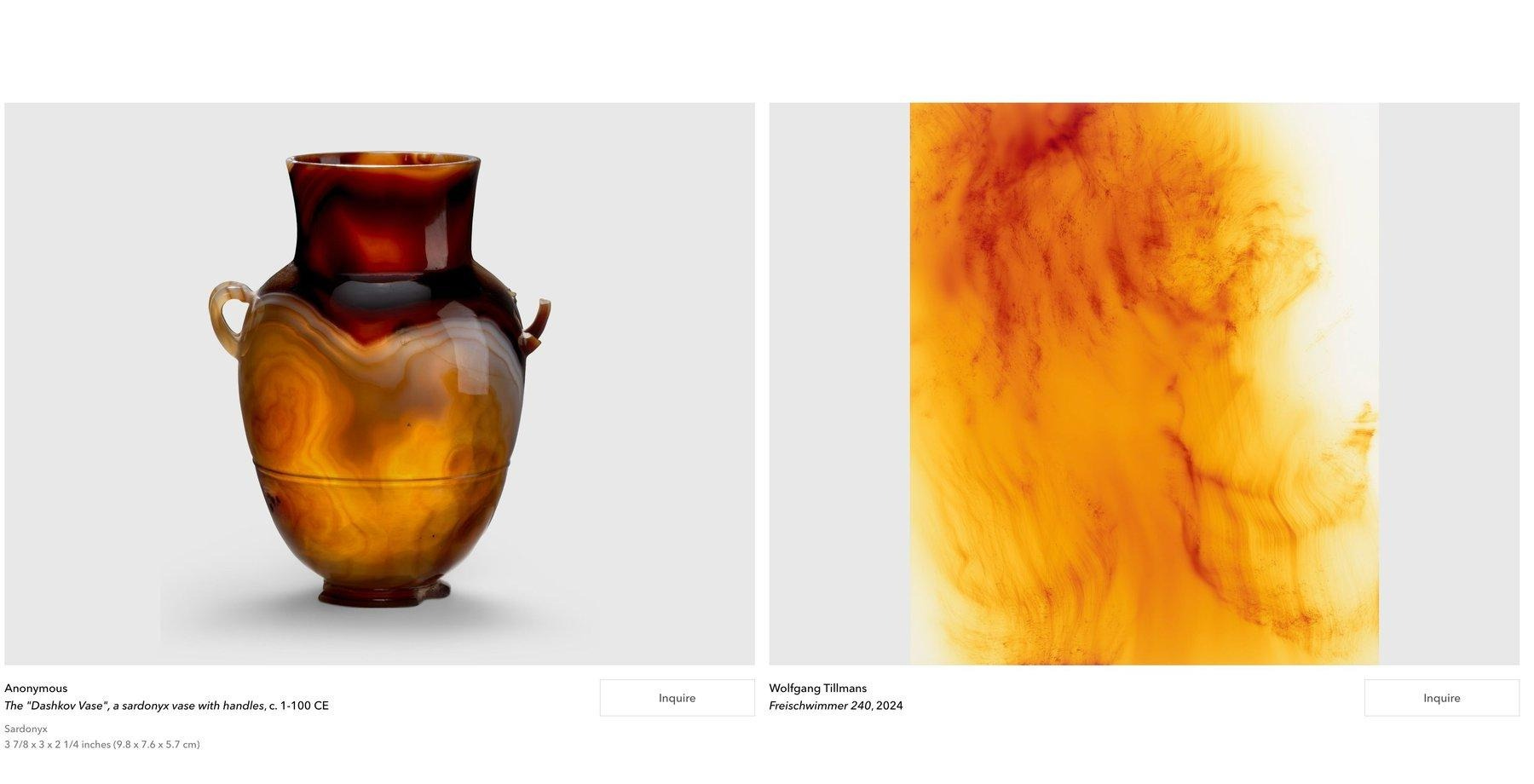
Got home and pulled the show up on the gallery’s website. Zwirner has built an “Explore” view for Set in Stone, antique and contemporary paired on one screen, the contemporary photographs lit past anything the room’s fixtures can do. The Dashkov Vase sits beside Wolfgang Tillmans’s Freischwimmer 240, a cameraless wash of orange and amber with no subject in it. In the room the vase is a small thing on a pedestal. On the screen it has been lit and color-matched until it almost answers the Tillmans, layer for orange-amber layer. I sent the screenshot to a friend who loves Tillmans.
The gallery will tell you the screen is its own exhibition, a "seventh space" level with the room, and it is, and honestly it might be the better one.4 Zwirner emailed me the real files after I inquired, behind a password the gallery gave me, lit past anything the room can do, and without that ask and that password they would not have reached me at all; even then they were too heavy to post here and too heavy to text, so what I actually sent a friend was a screenshot of the website, re-saved twice, the color a bit changed. It funny enough worked. She does not care about anything made before she was born and now she wanted the vase. Every image in this piece is one of those screenshots, the poor copy, the thing you have been looking at the whole time. Fidelity is expensive and it is slow. It travels, but only the way the gallery passes it, hand to chosen hand, settling into the institutions like sediment and never picking up speed. The copy carries none of that weight, which is exactly why it goes everywhere, and fast. The worthless one has the reach. The vase has the opposite, a full record of itself, every owner and every room it ever stood in, as heavy as the scan and moving at the same low speed, down through the sales and the archives, sediment again, and it keeps all of that and not the one thing that happened tonight, which is that she wanted it. The papers keep who held a thing and never who it changed, and what changes people is the orphan, the copy with no owner, no past, no line behind it, the only one light enough to get out of the building.5 The show would like to keep the object rare and let the picture run loose, and the second wish is the one it cannot take back.
The vase has a history of being edited. Carved from sardonyx, probably in Rome in the first century, then acquired in Rome in 1780 by Princess Yekaterina Dashkova, a friend of Catherine the Great and, in 1789, the first woman elected to the American Philosophical Society.6 At some point someone painted a watercolor over the carved stone. At some later point someone thought better of it and scraped it back off. What sits on the pedestal is already a decision about how much of the stone to let you see. The eighteenth century stripped a layer to get to it. The twenty-first puts one back: in the high-resolution photographs the light pushes the banding so hard that the brightest part of the base breaks into little geometric shapes, almost pixels, an image the stone cannot make on its own, possibly. Every century that has owned the thing has edited its surface to match the way that century happened to look. The show is just the latest to have a go.
The pairing works, and it took me a minute to see why. Tillmans makes his Freischwimmer pictures without a camera, in the darkroom, running controlled light across chromogenic paper, so the picture is just a record of light moving through a chemical depth.7 The Dashkov Vase is carved sardonyx, banded chalcedony, and its whole visual life is light moving through translucent layers of stone. Two thousand years apart and the same thing is going on in both, an image made by light passing through something you can see into, no painter and no camera anywhere in it. That gap is the pleasure, and it is a rare one. A vase from the first century next to a photograph from last year, and you feel the distance before you feel anything else. Then the pairing hands you a way of looking you can carry to the next object, and all of it arrives in the ten seconds you are standing there, no date or name or use required. The deepest thing in the show is the one that asks the least of you. If you go for one reason, go for this.
On the third floor a case was empty, four inches square. The card still beside it, the object gone.8 A pedestal, a light still aimed at where the thing had been, the dent in the felt. Something sold, that had sat next to a Parisian miniature bookcover from around 1630, agate and gold and enamel and diamonds and oil on vellum. A show like this does not hold still. It is open and selling at once, going out the way it came in, one object at a time, while you are standing there looking at the gap. By the time this review runs some of what it describes will be in transit, and somewhere there is paperwork for it, a condition report, an invoice, a crate built to the dimensions of the thing I never saw. The empty case is the transaction, on view.
The amber tankard in the same room belongs to two categories at once. Attributed to Jacob Heise, Königsberg, around the middle of the seventeenth century. I put its history together standing in front of it, half on my phone and half from the attendant, who was fielding a lot of questions. Königsberg and Danzig were the two amber towns, and the Brandenburg court sent carved amber abroad as diplomatic gifts.9 The Met has two like it, the carved panels set in silver-gilt mounts.10 Amber is fossilized resin, some forty million years old, brittle once it is cut thin. It reads as Translucent, for what it does to light. It is built as Assembled, panel by panel into a mounted vessel. The slippage is cool, and this deep into the show the categories stop mattering anyway. Carved amber like this was court business, made to be given, to cross a border and seal a pact. But the giving is older than the court. Amber had been moving from the Baltic to the Mediterranean since the Bronze Age, turning up in Mycenaean graves, a gift before it was ever a tankard. A gift like this is never only a thing. It carries rank and obligation and the bond between the hands that pass it on.11 It was a transaction before it was an object, and the gallery is the next set of hands to move it.
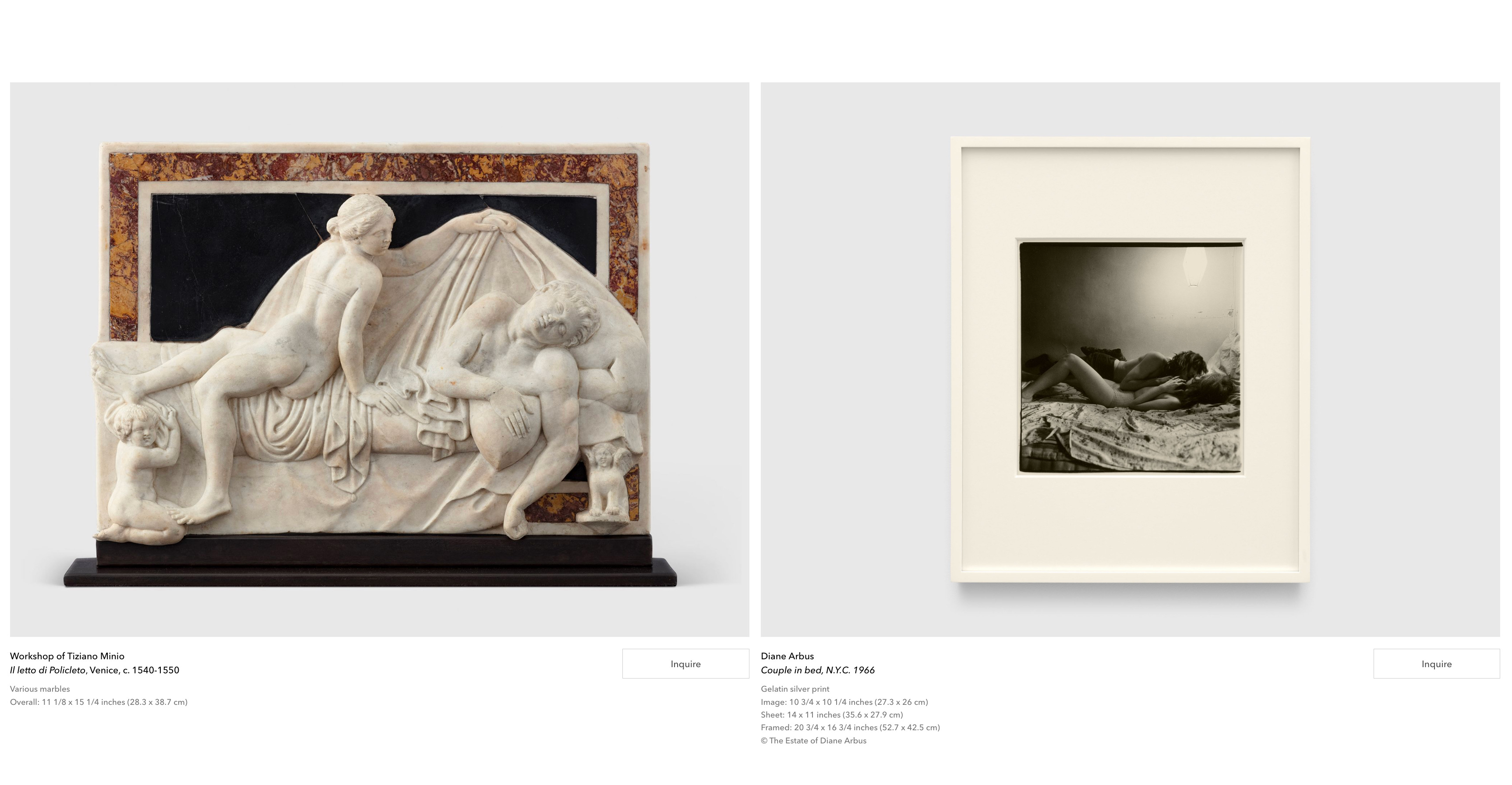
A marble relief of a couple in bed hangs next to a photograph of a couple in bed. The relief is the Workshop of Tiziano Minio, Bed of Polykleitos, Venice around 1540, a Renaissance copy of something older. The Arbus is Couple in bed, New York, 1966. Four centuries between them and the subject holds, two people lying down together, the rhyme you catch before you know anything about either. The marble makes the couple a myth, all drapery and putti and idealized stone. The Arbus is two specific people who by the look of them would rather be asleep. The reading on offer was two women, one on top. Maybe. The figure on top has long hair and could as easily be a man, and the print does not say. What is in the photograph is who is lying which way, and they both look tired. The rest, the dominance, the two women, is what the label added.

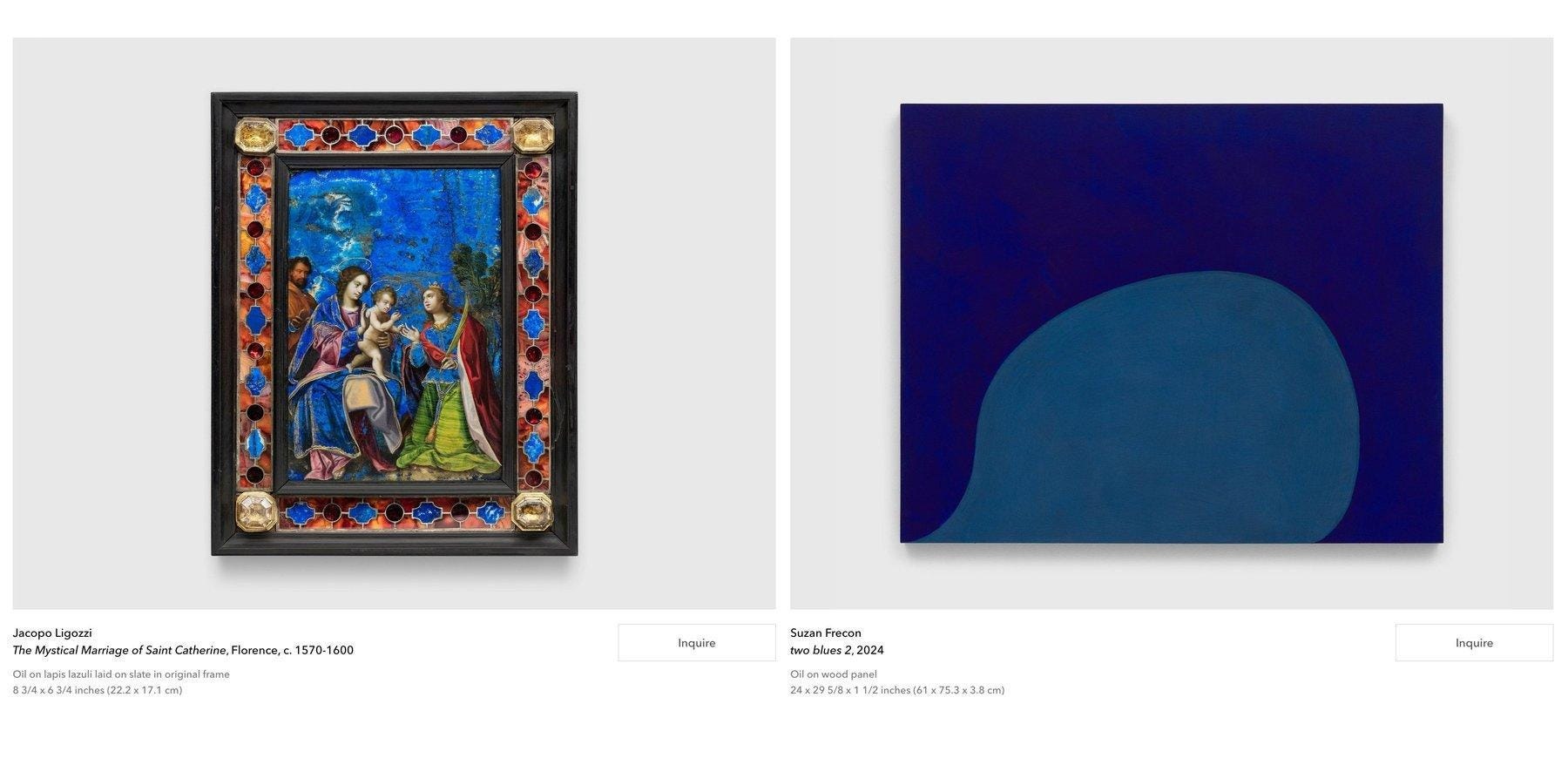
Suzan Frecon's two blues 2 hangs near oil paintings by Jacopo Ligozzi and Jacques Stella, and the link this time is the stone itself. Ligozzi and Stella painted on slabs of lapis lazuli, the stone as their support. Frecon ground her blue from the same lapis. The continuity is physical, lapis as a support in one century and as pigment in another. Three or four pairings out of more than fifty objects do work you can check. The rest are arranged by how they look together.
In the Colorless room a white painting hangs near a white marble. The painting is Robert Ryman, white on white, 1965, where the white is the whole subject, brushed and reworked as the thing itself. The marble is white the way stone is white, or the way stone goes white once its paint is gone. The category calls both Colorless and lets the one word carry the pairing. An absence is not a quality, and you can set any two things side by side on the strength of what they both lack. This is the room where the sorting shows its hand. Stand the painting next to the marble and they share an absence and not much else. The label holds anyway, for the viewer it was built for, the one who takes an absence for a theme and never checks whether the white means the same thing twice.
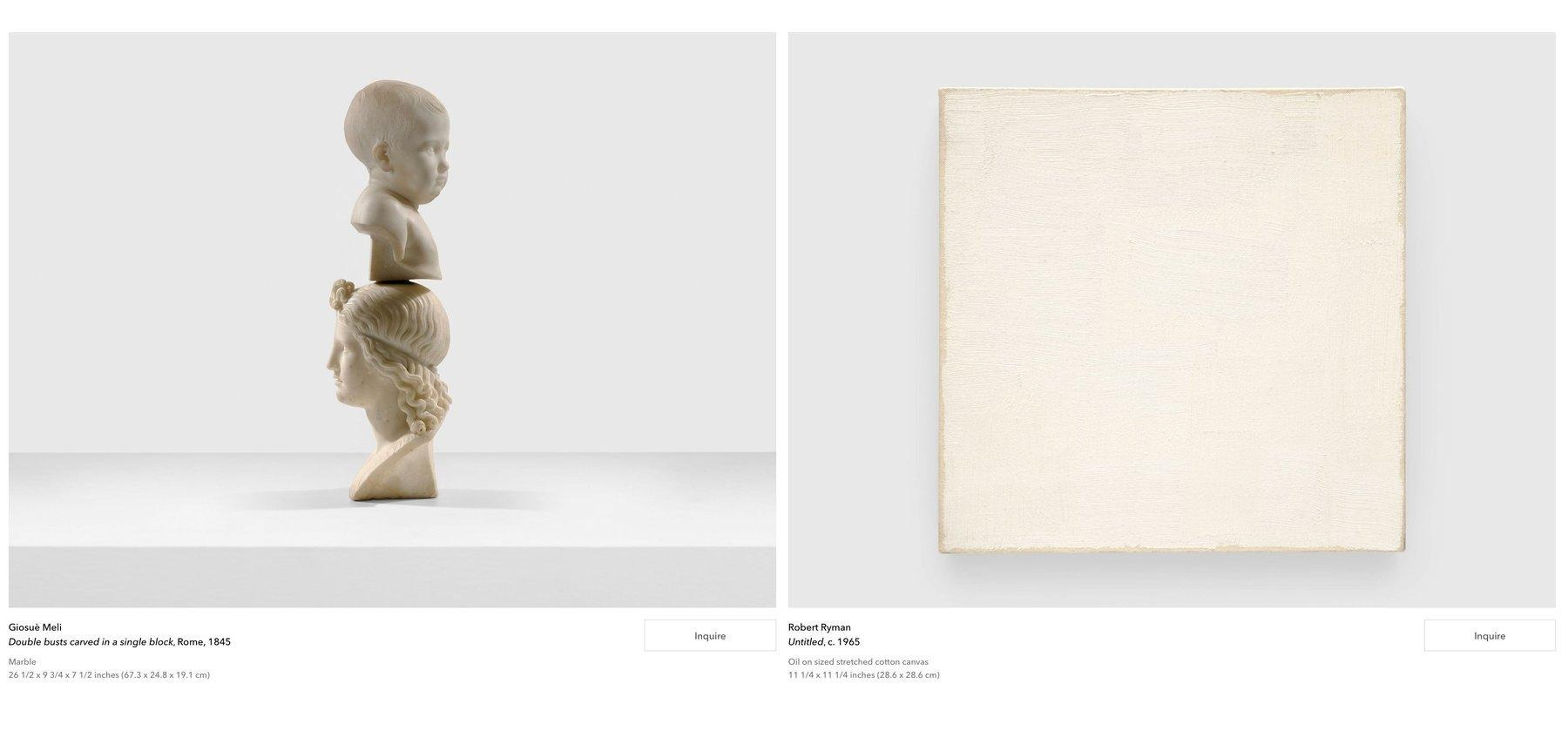
Jacob de Wit's Allegory of the Four Elements, around 1750, is a grisaille oil that paints sculpture so well that I stood in the doorway a second taking paint for stone. I played my game on it and lost, which here is partly the show's doing. The instinct works at the Frick because the room gives it something steady to push against. This room is two thousand years wide, and the instinct I developed has translational issues. A photorealist canvas could read as from 1975. The de Wit does it in 1750, a decorative object made for somebody's wall, two centuries before painting would get the credit. The Meli double busts from 1845 stack a child's head on a woman's out of one block of marble and read on first sight like a Brâncuși, or a Charles Ray, anything but a Roman virtuoso showing off. Put them together and the antique side starts to look like the repressed prehistory of the new names across the room, both already doing the thing the new work is praised for, the new work quietly losing a little of its claim to having invented anything. Sociologists will enjoy this more than anyone.12
You walk the block and the plain reading is the one nobody bothers to say out loud, which is that the trade is shrinking. Sales off something like twelve percent, the young speculative names, the red-chip ones you are hearing for the first time and the market may be hearing for the last, down forty-three, while the blue-chip end sits there placid and well fed.13All the money that used to sprint at the emerging, the unproven, the thrillingly cheap has wandered back uptown to lie down in things that cannot embarrass it, the way a nervous dog finds the dullest room in the house and settles. A show like this is built for that dog, for the weary buyer who no longer wants to discover anything, only to be told he was right, which is why the antiques are here too, the credenza with three centuries of owners stacked behind it, the depth, the lineage, the patina of every hand that ever touched it, set beside contemporary names picked for one virtue above the rest, that they come off the wall as easily as they went on. And none of it, you notice somewhere past the second viewing room, was made here; none of it was made for here. This stretch of the Upper East Side neither makes nor keeps, it only shows and moves, and what gives a thing its price here is the record of having been wanted by the right institutions, the museum acquisition or the museum-grade provenance folded in like a truffle shaving, so that what you are paying for is not the object at all but the rumor that it was once worth keeping, and a place in the line of everyone who kept it.14 Which is where it gets wonderful, because the four categories, the tidy on-ramp they have built for you, are there so you can take the object and set the history back down at the door, the clean thing, the thing unburdened by its past, and yet the history is the only part with a price on it; the object comes thrown in free, a complimentary tote bag clipped to the receipt, and you carry the canvas home as the parting gift that arrived with your purchase of its provenance. The museum decided it no longer wanted this, or could do without it, and that, precisely that, is what costs extra.
Underneath that is a harder one, for artists at least, that the contraction selects for what stores and thus what is being bought.15 A painting stacks flat in a warehouse and holds a price. A performance cannot be stored at all, and the mediums in between are going the way the middle of the market is going. A room like this is a catalogue of the survivors, the flat and the small and the durable, the work that behaves like an asset. The contemporary names here are already canonized, and the city that made them no longer keeps the makers who would come next. The show is the luxury end of a market that has finished eating its own middle.
Everything here reads twice. The amber tankard, forty million years of fossilized resin and a lot number at the same time, and the room is not going to settle that for you. I have been settling it, that is the whole essay, picking the better of the two readings off each thing like it mattered which one I landed on, and standing in front of the tankard I noticed I had been doing it for an hour and the tankard had not moved and was not going to until somebody with the money said so. Which is when the picking starts to feel like a thing I do to pass the time in rooms I cannot afford to be buying in. The invoice is the reading that counts. Mine is just the one that is free.
The second reading is the generous one, and it is the worse one. Almost everything on the Kugel side is decorative arts. Hardstone vases, marquetry, micro-mosaic, amber, malachite, pietra dura cabinets, gem-mounted reliquaries, craft objects made in their own time as functional luxury. A contemporary checklist of political or conceptual or performance work would have clashed with that side at the level of register, not only of medium. The Morandi, the Ryman, the Albers weaving, the Frecon, the Eggleston operate on the same plane as the decorative arts, formal and material and surface-attentive. They are register-matched to their antique partners, and that matching was a curatorial argument that these things are made for looking, which is also the only kind of art that sells smoothly when the market is a scared dog. Read all the way down, the generous reading is how the cynical one works.
A useful contrast sits six blocks north. For three years the Frick hung at the Breuer building with the labels mostly stripped, no didactic text, no glass, the painters' names written onto the old frames, the visitor left alone with the panels.16 The bet was that the objects could carry the tradition by themselves if the room got out of the way. Set in Stone makes the opposite bet. Four named rooms, a published interpretive frame, a website that lights the objects better than the gallery does. The Frick took the apparatus down and trusted the room. Zwirner built the apparatus into the wall label and the website. Both are wagers about how much looking a person can be left to do alone, and only one of them has something to sell you at the end of it.
This is the part of the show no one has written about. Kronman, Lucas Zwirner, and Laura Kugel are one cohort, three people in their thirties, two of them inheriting major dealer programs and the third building an advisory practice, working out what cross-period collecting looks like for the buyers who will replace the current ones. It looks like generational taste. It is generational money. A Cerulli projection has about one hundred twenty-four trillion dollars changing hands over roughly the next twenty-five years, roughly eighty-five trillion of it to Gen X and Millennial heirs.17 Cross-period collecting is what dealers build when an inheriting cohort wants depth and durability after a contraction has scared it off the speculative middle.18
What the footnotes hold, and the body keeps quiet about, is that provenance is the bond priced and inheritance is the same bond run down a bloodline, the largest one in the history of the species settling right now onto whoever happens to be standing under it, some kid who will spend a sliver he can't feel on amber and hardstone and a sardonyx vase that has outlived everyone who ever owned it and can prove more of where it has been than almost anyone in the room can prove of themselves, the dealers excepted, and, once you do the math on a thirteenth-century line and a dead emperor, me, though none of it is worth anything at a desk where the vase starts at seventy-five thousand. Which is the joke, or close to it. I wanted to be the kind of critic who reads the object and lets the label correct him, and I had been, all afternoon, getting it wrong on purpose and liking it, and then I got home and pulled the show up on my phone, screenshotted the vase against the Tillmans, and somewhere in the second app with the color half gone I couldn't tell you which of the four rooms it had been, Colorless or Translucent, one of the four, and found I didn't want to. The screenshot was fine, the way it is always fine, which is the thing nobody warns you about.
The coverage is its own evidence. The show is halfway through its run, and Elle Decor has covered it. The only other mentions are aggregators listing where openings are. No Artforum, no Frieze, no Art in America, no Brooklyn Rail, no Hyperallergic, no Times, no ARTnews market piece. The trade read it as an interior decor show. That is consistent with the four categories as pedagogy and the website built for phones, and it is the show working exactly as built. A thing pitched at the cohort who will buy these objects in five years lands first in the shelter magazines and reaches the criticism late, if at all.
The Palazzo Strozzi has five Rothkos installed in Fra Angelico’s frescoed cells at San Marco in Florence.19 Rothko sought those cells out himself in 1950, stayed until closing, and came back the next day. That pairing is devotional, and it is the better history of what a contemporary-into-historic hang can be. The Zwirner show turns the same devotion toward inventory. If a gallery or two stages a comparable antique pairing in the next year and a half, Set in Stone is the moment the move went mainstream. If none does, it is a stylish event during the contraction.
On the train home I kept circling the same question, who the show is actually for. The story is that the younger collectors came up aesthetically on Instagram and got burned on the volatility. Very few of them turn up where pieces start at seventy-five thousand dollars. The people with the money to buy a sardonyx vase are older than the story needs them to be. They learned pictures in print, came to the screen in middle age, and screenshot the way I do, wary of a life lived inside the computer in your hand. The show is fluent in an image language. The people who can afford it are still reading off the physical gallery guide. There is something almost touching about that.

Maria Bernheim left this in the comments after the piece ran, and I am folding her back into it, which is a thing you can do now: "Of course there are market reasons for this show. But I always think that it's pretty amazing that this is open to the public for free 6 days a week. And that few people have the chance to ever experience these works in person." She is right. The selling is why the looking is free, and the looking is genuinely free, and the second does not stop being a gift because the first paid for it. The most generous free hour on the block, built to move inventory, both at once.
Galleries have been importing this authority for over a decade. The documented version is the museum wave: in 2012 John Elderfield, MoMA's chief curator emeritus of painting and sculpture, crossed to organize special exhibitions at Gagosian; Pace built a curatorial department from 2018, poaching from MoMA PS1 and the Hirshhorn (ARTnews, "Top Museum Curators Are Joining Art Galleries," August 2023). I guess you can say that Kronman is the auction house and academy version rather than the museum one, if that makes sense. What the credential certifies either way is laid out, unintentionally, in Artnet's 2018 survey of how museum curators are trained ("What's the Best Path to a Top Museum Job?"): art-historical grounding is the thing that lets a curator judge what will last. The academic name for the move is Bourdieu's. Juxtapose curators within his economy of symbolic goods, the ones who win accumulate enough symbolic capital to consecrate, and consecration works only through the disavowal of the economic interest that is nonetheless its engine ("The Production of Belief," 1980, collected in The Field of Cultural Production, 1993). I am compressing quite a bit here and keep in mind Bourdieu was writing about French publishing and the Salon.
I talked at length with one attendant on the second floor, who pointed out Castrucci as a puzzle, noted that the white-wall treatment gave the Kugels’ objects a different context, I got the impression that their life with these things is unusually close, and told me a story about a couple who, like me, were untrained and enjoyed Ursuța most. In return I told her the one thing I learned from a year invigilating at Hauser & Wirth Los Angeles in 2018: the best part of the job is watching people who do not work in art look at art, and how often the read that gets written off as untutored turns out to be a more accurate account of what the thing is doing. She already knew that. Both attendants were warm about their galleries and about working there. I found it to be a quite fulfilling job that makes you feel very intimate with certain works.
Zwirner calls its online viewing room a "seventh space," a parallel exhibition in its own right on equal footing with its galleries. Ocula notes that Zwirner and Gagosian put their weight behind high-resolution viewing rooms over AR and VR, which is the elevated choice: VR is the emerging format, likely to age into a gimmick, and high resolution buys stable, durable image quality. The decision is fidelity all the way down. The mechanism that carries the work is Hito Steyerl's poor image inverted: she described the low-resolution copy that takes its power from speed and circulation, and here the gallery makes the most fidelity-conscious choice available to it and still depends on the screenshot, because velocity is a thing that could move a scared market.
The art historian Amanda Wasielewski makes the point that provenance, for all its detail about where a work has gone and who owned it, "rarely does account for influence," which runs in no straight line and down no family tree and has little to do with ownership, a gap she ties to how hard digital images are to keep hold of once they start reproducing. Her case is Meyer Schapiro handing Fernand Léger a tenth-century manuscript at the Morgan in the 1930s and watching it surface in Léger's paintings a decade later, influence skipping a thousand years and crossing no chain of title at all. See "Interfaces of Art: Meyer Schapiro, Fernand Léger, and the Role of the Art Historian in Anachronistic Artistic Influence," Journal of Art Historiography, no. 26 (June 2022). I am lending her thinking through the logic of a screenshot and a friend's wanting, which is not her example, but it is her mechanism and it’s ok because this is Substack.com. Thank you to Leia Immanuel.
Kugel’s 2010 catalogue Anticomania, designed by Pier Luigi Pizzi and shown at the Hôtel Collot in the autumn of 2010, calls it “le précieux ‘Vase Dashkov’ en sardoine, acheté à Rome en 1780 par la princesse Dashkov, meilleure amie de l’impératrice Catherine II,” dated “probablement Rome, Ier siècle ap. J.-C.,” and just under ten centimeters tall. See galeriekugel.com/en/publications/anticomania and Alain Truong’s writeup, “Anticomania @ Galerie J. Kugel,” from December 2010. On her being the first woman elected to the American Philosophical Society, back in 1789, the APS says so itself at amphilsoc.org/elected-members. The standard source in English is Sue Ann Prince’s edited volume The Princess and the Patriot: Ekaterina Dashkova, Benjamin Franklin, and the Age of Enlightenment, which the APS published in 2006, and on the gems specifically there is an Oleg Neverov piece in the Journal of the History of Collections, a 1990 issue, pages 63 to 68. The watercolor-painted-over-the-stone story is Kugel’s, told to me by gallery staff during the run. I could not find it published anywhere independent, so take it as the gallery’s account and not as mine.
Tillmans started the Freischwimmer pictures in 2003. He doesn’t use a camera. It’s an experiment in the darkroom where he runs controlled light across chromogenic paper, then scans and blows up the sheet. His own description, from the catalogue of the 2004 Tokyo Opera City show Freischwimmer: “Literally, Freischwimmer means something like ‘swimming freely’… they’re made purely through the manipulation of light on paper… This intuitive recording and application of light, while a physical process, is at the same time liberated from a linguistic or painterly gesture of complete control.” Painting without a brush is basically the same as photography without a camera he is saying. The vase next to it is carving without as well and by the time you are looking at it, maybe, a carver you can name.
The third-floor attendant, whose name I did not get, told me the empty glass case in the Translucent room had held an object that sold and got pulled during the run. I am not naming the object because I never saw it and the checklist does not flag what has sold. What I can report is the placement, next to the Parisian miniature bookcover (KUGEL0021 on the checklist). What was in the case I genuinely do not know.
On the seventeenth-century Prussian amber trade and amber as diplomatic currency, see Tomasz Grusiecki's "Locating the Material: Prussian Carved Ambers, Place Ambiguity and a New Geography of Central European Art," in German History, the September 2023 issue, pages 444 to 471. Grusiecki's point is that both the Hohenzollerns of Brandenburg-Prussia and the Vasas of Royal Prussia handed carved amber around as gifts to seal pacts; Königsberg and Danzig were the two production centers, Danzig pulling ahead by mid-century. The Königsberg guild was set up in 1641. The material itself is older than the politics by a wide margin: fossilized Eocene resin, somewhere around thirty-five to forty-seven million years old. A diplomatic gift made of deep time.
The Met has two comparable seventeenth-century Königsberg tankards, with mounts by Andreas Meyer, who worked in Königsberg in the first half of the century. Carved amber panels held in metal armatures, not fused amber. The Heise attribution on the Kugel piece is the gallery’s.
Baltic amber was moving south to the Mediterranean by the Bronze Age and turns up in Mycenaean shaft graves, which puts a seventeenth-century Königsberg tankard at the tail end of an exchange system thousands of years old. A recent synthesis on amber in the eastern Baltic calls amber objects "symbolically recognizable carriers of social information," nodes for alliance, prestige, and identity in forager societies, the material doing social work long before it did decorative work. The frame is Marcel Mauss's: in The Gift (1925) the prestige objects that pass between chiefs, shells and heirlooms and talismans, are never only things; they carry rank and the relationship between giver and receiver, and to refuse one is to refuse the bond. The same practice runs today under quieter names. Provenance is the priced version, the record of whose hands a thing has passed through, the bond turned into an asset, and it is most of what the buyer is paying for. Inheritance is the version run across generations, and it is the practice this whole show is built around: a cohort about to receive the largest gift in history, spending it on objects that carry rank. The tankard's passage now, Paris dealer to New York show to whoever carries it home, is one more move in a system older than any of its names.
The best account I know of what the Frick Madison pulled off is Dean Kissick’s “Return to Tradition,” for Spike, spring of 2021. He goes on a beautiful day, sits with the paintings, lets a stranger tell him the angels in the Duccio were added later and throw it off balance. The hang was stripped to almost nothing, no glass, no didactics, painters’ names written onto the old frames, which he calls “a pure experience” where “you can really get close to the paintings.” It was in the same neighborhood as Zwirner, but the opposite bet about how much the viewer can be trusted to do alone, and the contrast kind of writes itself. The Bellini he sits with in that piece, the St. Francis, is back on 70th Street now, apparatus and all, and I still bring the essay up when I take friends to stand in front of it. You should go stand in front of it. Everyone seems to barely look at it when I’ve been there.
The figures are from Dr. Clare McAndrew’s Art Basel and UBS Global Art Market Report, the 2025 edition, out in early April. Global sales down twelve percent to $57.5 billion in 2024, a second straight down year; auction sales off twenty-five percent in public sales; Post-War and Contemporary down twenty-eight percent to $4.6 billion; ultra-contemporary, meaning artists born in or after 1970, down forty-three percent to $1.1 billion, which is the speculative middle the body paragraph means. Work over $10 million dropped to eighteen percent of market value, from twenty-three the year before and thirty-three the year before that. Transaction volume grew three percent though, to 40.5 million lots. Fewer of the big sales, then, and more of the small ones, the expensive end mostly fine and the part where the speculation lives getting quietly hollowed out. ARTnews, CNN, and Artlyst all ran it the day it dropped.
The cleaner version of this is the auction house, not the private gallery, which is worth saying because the body sentence leans on the gallery channel and the gallery channel is the smaller one. When a museum lets something go it almost always goes through Sotheby's or Christie's, where the deaccession is public and the ethics rules account for it, the proceeds ring-fenced for new acquisitions or the direct care of what's left, the whole thing done in daylight so nobody can say the museum sold off the public's pictures in the dark, and quiet private resale through a dealer does happen but it is the exception and a more fraught one, because the entire value of the brass label depends on the institution having wanted the object in the first place. Georgina Adam puts the premium plainly in The Art Newspaper, that museum provenance adds the lustre of validation and with it monetary value, which is the mechanism the whole block runs on. So what travels into a price is the wanting, not the letting go. Kugel runs the arrow the other way anyhow, it sold the Frick its ewer, and the museum's having acquired the thing is now part of what the next owner would pay for it, validation accruing in the direction the gallery actually profits from. Either way the asset is the institutional yes, and the object is more or less along for the ride.
See Josh Kline’s essay in October. If you are reading this, you likely already read my response.
The $124 trillion is Cerulli Associates', from The Cerulli Report on U.S. High-Net-Worth and Ultra-High-Net-Worth Markets 2024, out in December 2024 and quoted everywhere since; I came to it through Fortune. Cerulli runs the projection to 2048. Of the $124 trillion, $105 trillion goes to heirs and $18 trillion to charity. The $85 trillion is the Gen X and Millennial slice of the heirs' share, $39 trillion to Gen X and $46 trillion to Millennials. A little over $54 trillion of the total passes first to surviving spouses, almost all of them widows.
Andrea Fraser, from her interview with J.J. Charlesworth in ArtReview in the spring of 2019: “The most fundamental structural challenge is the fact that the enormous global expansion of the art field in the past decades was enabled by the massive influx of highly concentrated private wealth. The artworld is not sustainable at its current scale without that wealth and would not be even if public funding were restored to peak, postwar and pre-austerity levels.” A scruple: Fraser is talking about concentration, the upward redistribution since the 1970s, not the generational transfer I am leaning on in the body, and I do not want to draft her into an argument she did not make. The two sit next to each other, though. Concentration is the condition the market has lived downstream of for fifty years; the wealth transfer is the machinery moving that concentrated money to a specific inheriting cohort right now, and the people who organized Set in Stone are standing exactly where the two meet. She makes the harder version of the point in her book 2016 in Museums, Money, and Politics, the one from 2018: “as the income share of the top one percent doubled from eleven percent in 1984 to over twenty-two percent in 2016, giving to the arts, culture, and humanities grew from $3.85 billion to $18.21 billion.”
The pleasure is real and specific to the discipline: you take something everyone calls new, and you show it was already there, baked into social practice, centuries before anyone thought to name it. Half of sociology is that move. The placard game played on the present, basically, and I am an amateur at it and enjoy it anyway.
"Rothko in Florence," at the Palazzo Strozzi together with the Museo di San Marco and the Biblioteca Medicea Laurenziana, running from the middle of March into late August 2026, curated by Christopher Rothko and Elena Geuna. The Strozzi retrospective comes with two satellite interventions under the Ministero della Cultura: five Rothkos in Fra Angelico's frescoed cells at the old Dominican convent of San Marco, two works on paper in Michelangelo's Laurenziana vestibule. The foundation's line is that "Angelico's quiet devotional imagery and Rothko's abstract compositions both attempt to express inner states that lie beyond ordinary representation." Rothko first went to San Marco in 1950. I am not saying one show is sincere and the other is cynical. I am saying it is the same gesture, and the gesture does not tell you which one you are looking at. You have to decide that yourself, which is the placard game again, now with the stakes turned up.
 | A guest post by
|
“The gap is the pleasure” is a perfect collection of words
Of course there are market reasons for this show. But I always think that it’s pretty amazing that this is open to the public for free 6 days a week. And that few people have the chance to ever experience these works in person.